Registration Flat Icon: A Designer’s Embroidery Review
As a designer who spends half my life digitizing and the other half stitching, I have learned that not every graphic translates well to thread. We often browse marketplaces for design assets, seeing clean lines and perfect vectors, but we must ask the critical question: how will this actually look once it is stitched out? Today, I am evaluating the Registration Flat Icon. This is not just a theoretical review; I am looking at this piece through the lens of real-world application, considering its utility for machine embroidery design projects, client work, and small business inventory.
First Impressions and Visual Personality
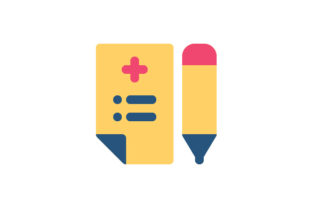
The Registration Flat Icon arrives with a specific pedigree. It is built on a 32px grid, with the object itself pixel-perfect at 28px and utilizing a consistent 2px line weight. For those of us in the digital space, these numbers signal precision. However, for the embroidery community, they signal something else entirely: potential scaling challenges. The design is categorized under Icons and Graphics, specifically tailored for medical purposes. Visually, it exudes cleanliness, authority, and clarity. There is no clutter. The mood is professional and sterile, in the best possible way. It feels like a symbol you would trust on a hospital badge or a high-end wellness brand.
When I first opened the files—EPS v10, AI CS6 or later, and SVG—I appreciated the vector quality. These formats are essential for resizing without losing integrity before we even begin the digitization process. But remember, this product is a graphic source, not necessarily a pre-digitized embroidery file ready for your machine. This distinction is vital. You are buying the blueprint, not the stitched house. This gives you creative control but requires technical skill to convert into a stitchable format.
Real-World Application: The Medical Tote Scenario
To truly test the viability of this icon, I imagined a recent client request. A local nursing student wanted custom custom apparel for her clinical rotations. She needed something subtle yet identifiable, something that wouldn't look like a childish cartoon but still added personality to her scrubs or tote bag. The Registration Flat Icon fit this brief perfectly.
I envisioned this design placed on a heavy canvas tote bag design. The 2px line weight, when scaled appropriately, translates beautifully into a clean running stitch or a light satin stitch border. On a textured fabric like canvas, the simplicity of the icon prevents it from getting lost in the weave. If I were to use this for a sweatshirt embroidery project, the stark contrast of white thread on navy blue fleece would make the icon pop. It serves as a badge of honor, a subtle nod to the profession without being overly loud. For Etsy sellers specializing in graduation gifts for healthcare workers, this kind of minimalist imagery is currently trending. It moves away from the overly complex, thread-heavy designs of the past and embraces modern, flat aesthetics.
Navigating Technical Challenges in Stitching
While the design is elegant, its simplicity is a double-edged sword. Because the Registration Flat Icon relies on thin lines and open space, it demands respect during the digitization phase. If you are converting this SVG or AI file into an embroidery project, you cannot simply auto-digitize and hope for the best. Thin lines on stretchy fabrics can easily pucker or disappear.
Consider the stitch density. If you use a fill stitch for a 2px line, it will become a bulky, raised mess. Instead, this design calls for precise running stitches or very narrow satin stitches. You must also consider the hoop size. While the original grid is small (32px), you will likely need to scale it up significantly for embroidery. Scaling up too much without adjusting stitch types can lead to gaps where the fabric shows through unintentionally. Conversely, keeping it small for a embroidered patch or a cap front requires meticulous attention to detail. Tiny corners can bunch up if the underlay is not correct.
Fabric choice is equally critical. This icon would struggle on highly textured towels or loose-knit sweaters unless properly stabilized. A cut-away stabilizer is non-negotiable here to maintain the crispness of the lines. On dark fabrics, you must ensure your thread colors have enough contrast. A grey thread on black fabric will render this icon invisible. For baby embroidery items, such as a onesie for a "future doctor," the softness of the thread and the stability of the knit fabric must be balanced carefully to avoid irritation and distortion.
Commercial Value and Brand Consistency
For craft business owners and small shop product creators, consistency is key. The Registration Flat Icon offers a level of professionalism that elevates perceived value. When customers see a clean, well-executed icon, they associate it with quality. This is particularly important for commercial embroidery clients who need branding on uniforms or promotional items. A messy, poorly digitized icon suggests carelessness; a crisp, clean one suggests expertise.
Using this icon in printable mockup previews can also boost sales. Because the source files are high-quality vectors, you can create stunning digital presentations for your online store. Show the icon on a crisp white lab coat, a sleek water bottle, or a minimalist notebook. These visuals help buyers envision the finished product before they purchase. It builds trust. For holiday embroidery gifts, such as a personalized kit for a medical professional, this icon serves as a perfect central element that can be paired with text or other decorative accents without overwhelming the design.
Practical Notes for the Embroidery Designer
Before you commit to stitching this design on a final garment, follow these practical steps. First, always test the design on scrap fabric that matches your final project. Check how the fabric texture interacts with the stitches. Second, review the digitized file for jump stitches and trim points. Efficient pathing saves time and reduces thread waste. Third, confirm the licensing terms. While the product description mentions the file formats, it does not explicitly state commercial usage rights for the digitized output. Always clarify whether you can sell items made with this design or if it is for personal use only. This is crucial for Etsy seller compliance and legal safety.
Additionally, test the design in black and white. If it loses its definition without color, it may rely too heavily on hue rather than shape. A strong icon should hold up in monochrome. Finally, consider the end-user. Will this item be washed frequently? If so, ensure your stitch density and stabilizer choice can withstand repeated laundering without fraying or losing shape.
In conclusion, the Registration Flat Icon is a potent tool for the modern embroiderer. It bridges the gap between digital precision and tactile craft. It requires skill to execute well, but when done right, it produces a personalized gift or commercial product that looks sharp, professional, and deeply considered. It is not just a graphic; it is a statement of quality waiting to be stitched.